
Research
I am a research scientist and co-lead of the Geneva Disease Dynamics group in the Faculty of Medicine at University of Geneva. I work at the interface of infectious disease epidemiology and global health policy and my research aims to characterize the spatiotemporal dynamics of infectious diseases and improve disease surveillance and control.
Enhancing oral cholera vaccination targeting through systematic testing
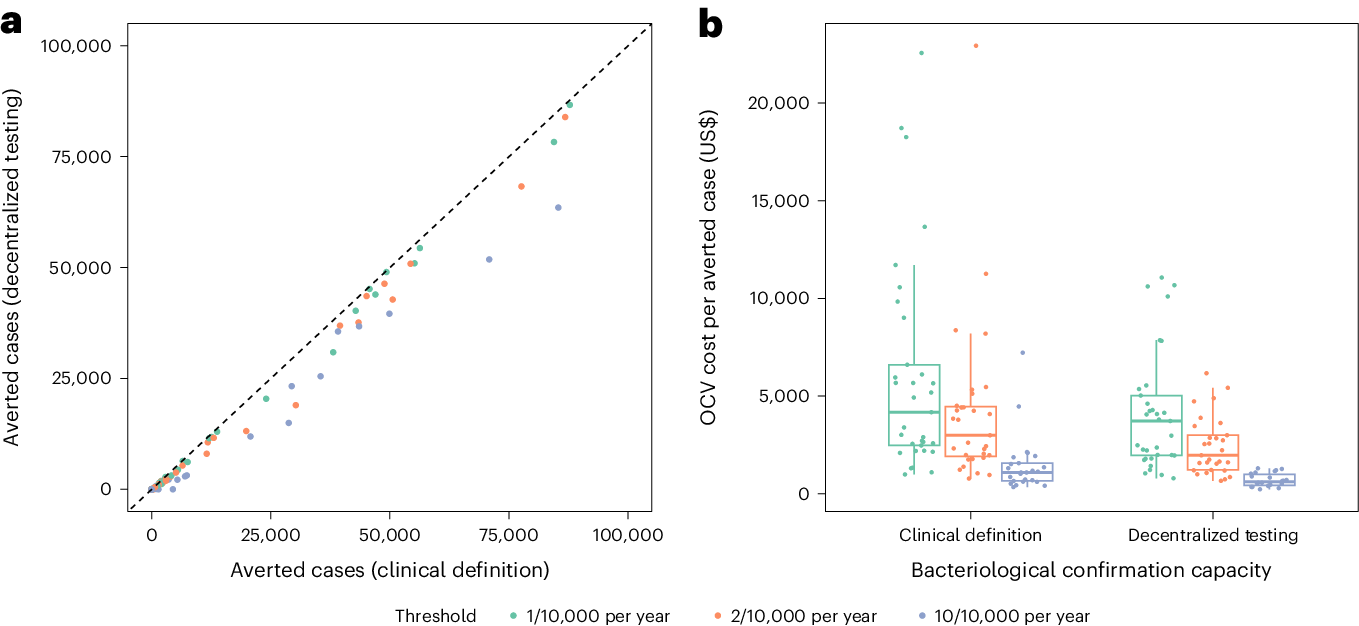
Most suspected cholera cases are not tested for Vibrio cholerae. Integrating systematic testing into cholera surveillance systems, even with imperfect rapid diagnostic tests, could yield large gains in efficiency and cost savings in the geographic targeting of mass oral cholera vaccination campaigns.
Check out our manuscript at Nature Medicine
Geographic targeting oral cholera vaccination in sub-Saharan Africa
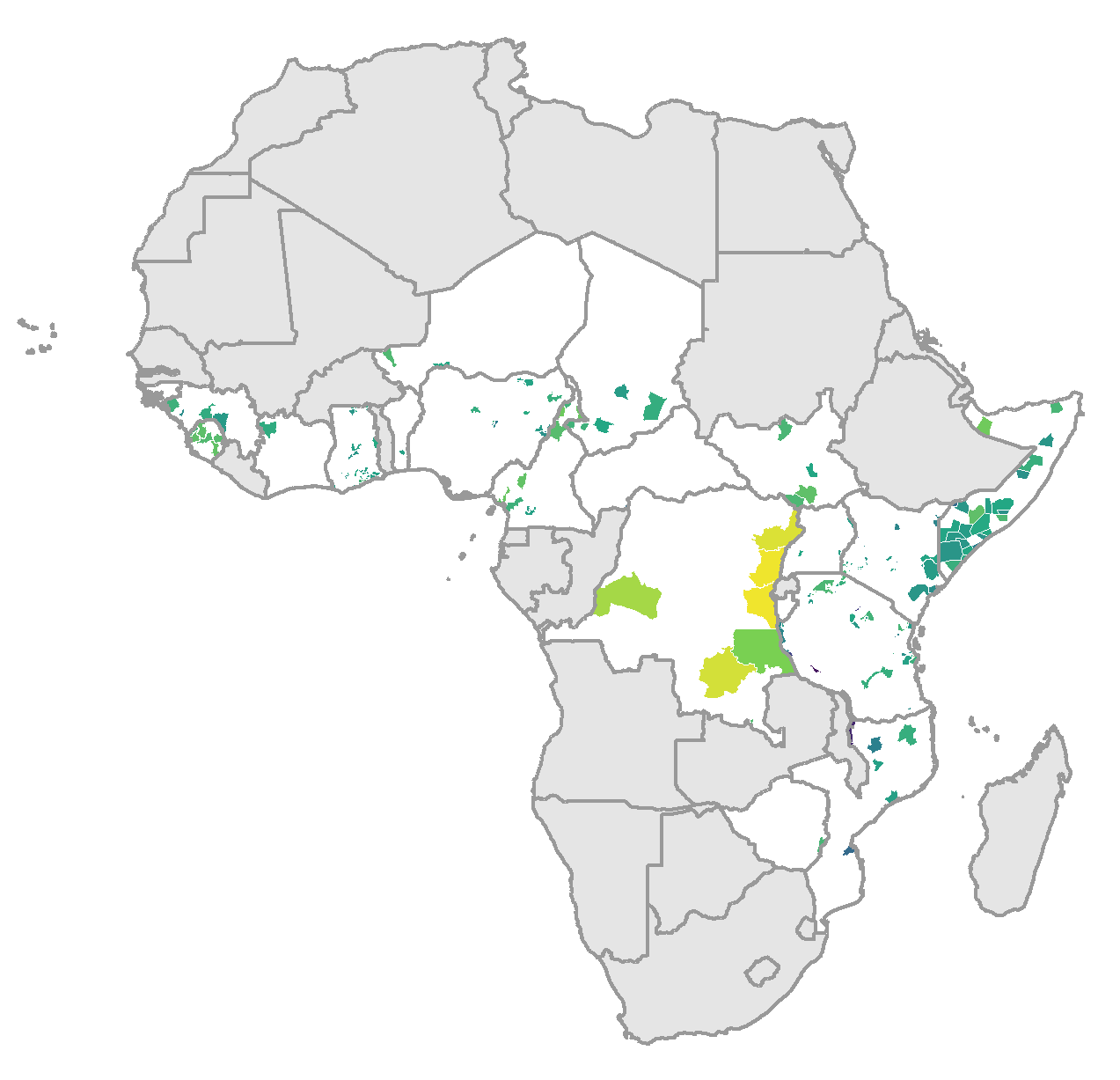
With rising global supplies of oral cholera vaccine (OCV) and a recent World Health Assembly declaration to reduce global cholera mortality by 90% by 2030, cholera-affected countries are moving towards the routine use of OCV for cholera control. To inform the future guidelines for OCV introduction, we assessed the health impact and cost-effectiveness of targeting OCV campaigns geographically according to historical cholera burden and risk factors across sub-Saharan Africa. Under current vaccine supply projections, an approach optimized to targeting by historical burden averted over 800,000 cholera cases from 2018 through 2030, as compared to less than 300,000 cases averted with an approach optimized to targeting by lack of access to improved water. Our models suggest that geographic targeting can have a much greater impact on the cost-effectiveness of OCV campaigns than moderate increases in vaccine efficacy, vaccination coverage, and vaccine supply. While OCV campaigns can serve as a cost-effective cholera control tool in the near-term, rapid progress in developing water and sanitation services is needed to achieve the ambitious 2030 goals.
Check out our manuscript at PLoS Medicine
Optimizing influenza surveillance with digital health data
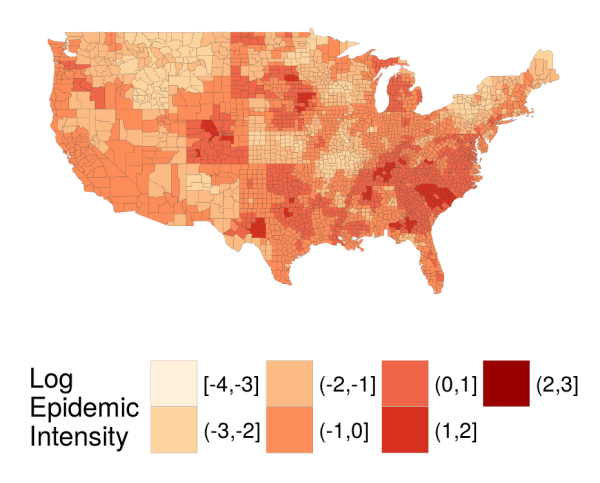
The surveillance of influenza activity is critical to early detection of epidemics and pandemics and the design of disease control strategies. Case reporting through a voluntary network of sentinel physicians is a commonly used method of passive surveillance for monitoring rates of influenza-like illness (ILI) worldwide. Despite its ubiquity, little attention has been given to the processes underlying the observation, collection, and spatial aggregation of sentinel surveillance data, and its subsequent effects on epidemiological understanding. We harnessed the high specificity of diagnosis codes in medical claims from a database that represented 2.5 billion visits from upwards of 120,000 United States healthcare providers each year. Among influenza seasons from 2002-2009 and the 2009 pandemic, we simulated limitations of sentinel surveillance systems such as low coverage and coarse spatial resolution, and performed Bayesian inference to probe the robustness of ecological inference and spatial prediction of disease burden. Our models suggest that local mobility, state-specific vaccination and health insurance policies, and sampling effort may be responsible for the spatial patterns in U.S. sentinel ILI surveillance. In addition, biases related to spatial aggregation were accentuated among areas with more heterogeneous disease risk, and sentinel systems designed with fixed reporting locations across seasons provided robust inference and prediction. With the growing availability of health-associated big data worldwide, our results suggest mechanisms for optimizing these digital data streams to complement traditional surveillance and enhance surveillance in developing countries.
See this work in PLoS Computational Biology
Winter holidays and influenza dynamics
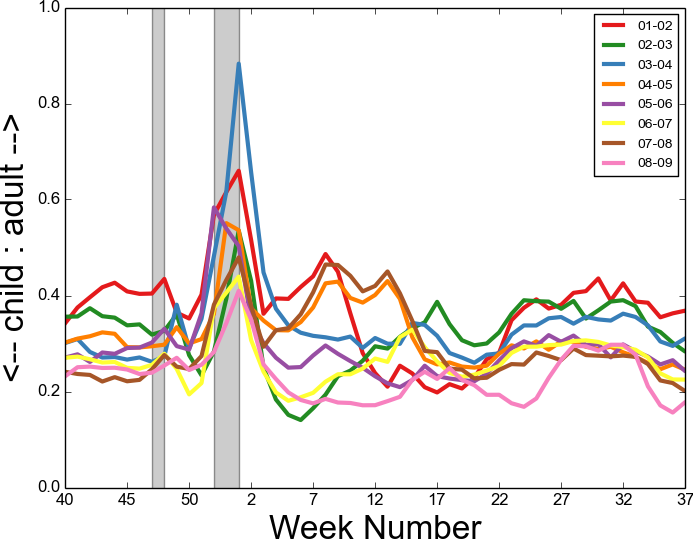
Influenza spread among human populations is characterized by a strong seasonality in the Northern Hemisphere. Low levels of year-round flu activity are marked by seasonal increases during the winter months; active flu surveillance and vaccination campaigns in the United States endure from October to March in typical seasons. Because children are a relatively susceptible population and classrooms enable children to contact many other individuals on a regular basis, school settings are thought to play a significant role in population-wide influenza spread. Many studies about the role of schools in influenza spread conflate planned school holidays with reactive school closures, and most studied closures are the result of pandemic influenza outbreaks. We expect, however, that school holiday induce population-level changes to disease-causing contact patterns and travel behaviors, and that these changes differ between planned and unplanned closures and seasonal and pandemic outbreaks. The goal of our study is to characterize the downstream effects of holiday contact and travel patterns on population-level transmission rates and spatial spread among children and adults.
See this work at The Journal of Infectious Diseases
Age patterns predict influenza season intensity
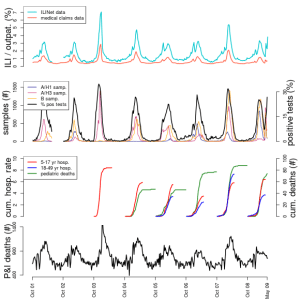
Measures of population-level influenza severity are important for public health planning, but estimates are often based on case-fatality and case-hospitalization risks, which require multiple data sources, are prone to surveillance biases, and are typically unavailable in the early stages of an outbreak. Research on population contact structure suggests that school-aged children are responsible for the bulk of influenza transmission and have the high morbidity because they have the greatest number of contacts, while adults have greater prior immunity, a more heterogeneous immune landscape, and are responsible for connecting high-risk groups to highly connected groups. We are interested in leveraging our knowledge of age-related contact structure and data on age-specific morbidity to develop a proxy for population-level severity. Elucidating the differences between children and adults in flu epidemiology can help public health policymakers target their interventions to reduce health and cost burdens on individuals and healthcare facilities and systems.
See this work in BMC Infectious Diseases – here’s my associated online tool related to influenza severity.
Cholera transmission and loss of immunity
Cholera is a waterborne intestinal infection that causes 3-5 million cases and over 100,000 deaths per year globally. Due to the complex transmission and immunity dynamics of cholera, mathematical models for cholera vary greatly in their structures, in terms of transmission pathways and loss of immunity mechanisms. In this study, we developed multiple mathematical models of cholera transmission and loss of immunity to explore model identifiability, accuracy in parameter estimation, and epidemic forecasting using simulated datasets and empirical data from the 2006 cholera epidemic in Angola. Our goal was to develop an understanding of the types of cholera models best used for parameter estimation and epidemic forecasting in epidemic scenarios, and to shed light on unidentifiable model parameters in order to inform future cholera data collection and study design.
See this work at the Journal of Theoretical Biology
 Elizabeth C. Lee